
Insight
Subscriber Growth vs Subscriber Profit: The Financial Blind Spot in Telecom
In the telecommunications industry, subscriber growth is often celebrated as the ultimate indicator of success. New customers, expanding coverage, and rising user numbers create the appearance of momentum. But for many telecom operators, there is a critical question hiding behind those impressive growth charts:
Are those subscribers actually profitable?
This is one of the most common financial blind spots in telecom companies. Many operators focus heavily on increasing subscriber counts without having a clear view of the true profitability per subscriber. As a result, companies may unknowingly scale unprofitable growth — adding customers who generate revenue but do not fully cover the cost required to acquire, serve, and retain them.
Over time, this creates pressure on margins, cash flow, and capital allocation.
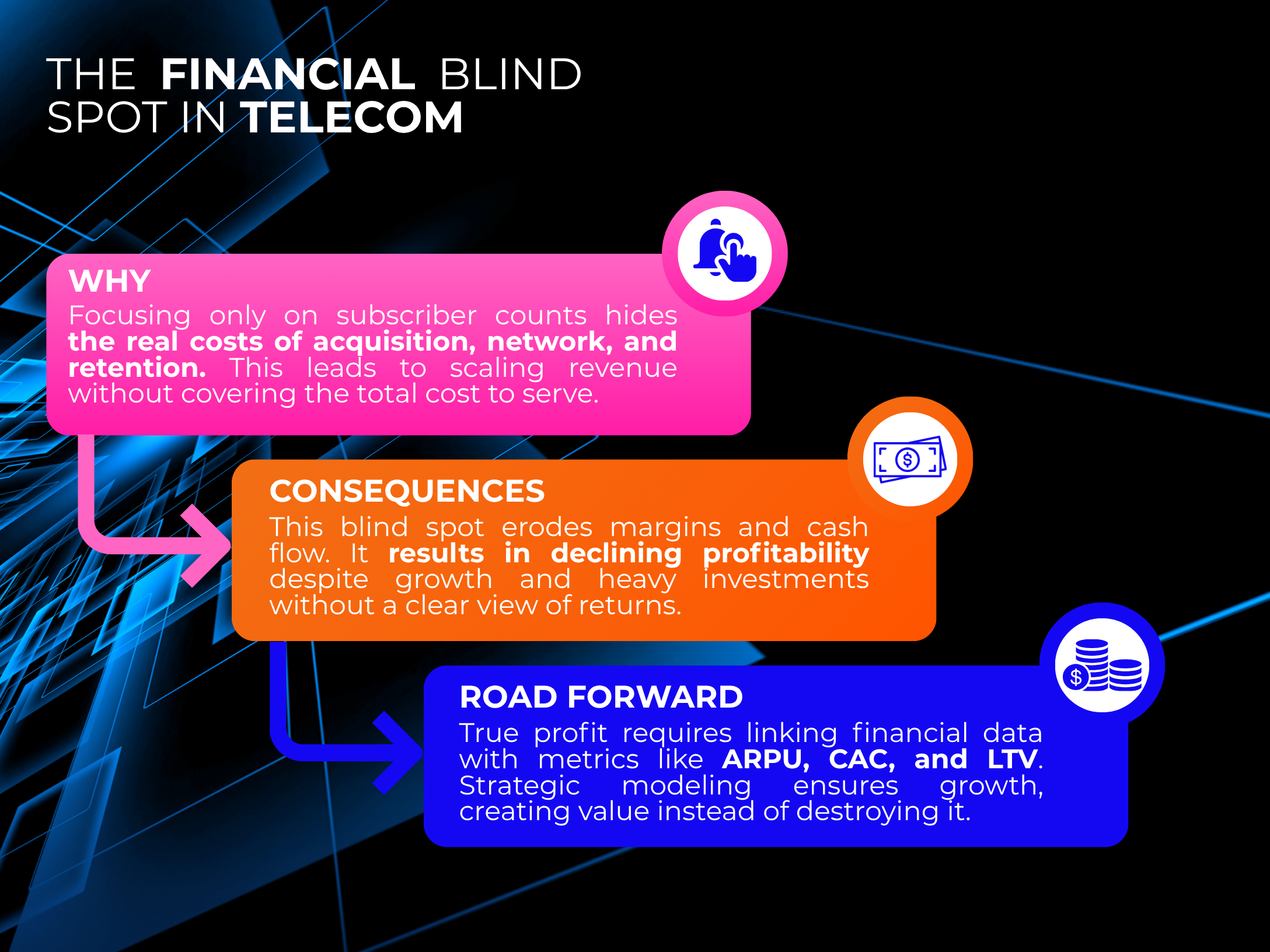
Why This Happens
Telecom companies operate in a complex environment where multiple cost layers affect each subscriber. These include:
- Subscriber acquisition costs (marketing, promotions, commissions)
- Network infrastructure and capacity costs
- Customer service and technical support
- Billing, systems, and administrative expenses
- Churn-related replacement costs
Traditional financial reports rarely connect these operational costs directly to subscriber behavior. As a result, executives often see revenue growth but lack visibility into subscriber-level profitability.
The consequences are familiar to many telecom leaders:
- Rapid subscriber growth but declining margins
- Heavy capital investment without clear return visibility
- Difficulty understanding which plans, markets, or customer segments drive profit
- Financial dashboards that do not reflect telecom operational realities
Without the right financial framework, leadership teams are forced to make strategic decisions with incomplete information.
What Profitable Growth Actually Requires
To truly understand subscriber profitability, telecom operators need a financial structure that connects financial data with operational telecom metrics.
This includes tracking key indicators such as:
- Average Revenue Per User (ARPU)
- Customer Acquisition Cost (CAC)
- Subscriber Lifetime Value (LTV)
- Churn-adjusted revenue
- Cost per subscriber
When these metrics are integrated into a strategic financial model, leaders can answer critical questions:
- Which customers are truly profitable?
- Which markets generate the best returns?
- Are new subscriber campaigns creating value or destroying it?
- Is network expansion financially justified?
Turning Financial Visibility into Strategy
This is where specialized financial expertise becomes critical.
At RAV Strategic Business Solutions, we help telecom operators build financial frameworks that go beyond traditional accounting. By aligning telecom operational metrics with financial modeling and strategic dashboards, leadership teams gain the clarity needed to make confident decisions.
Subscriber growth is important — but profitable subscriber growth is what builds sustainable telecom companies.
Understanding the difference may be the most important financial insight your organization can gain.
See the real profit behind the growth