
Insight
Fiber Expansion: The Financial Model Most Operators Miss
Fiber expansion is one of the most powerful growth levers for telecom operators. It promises higher speeds, stronger customer retention, and long-term competitive advantage. But behind the opportunity lies a critical reality:
Many operators invest in fiber without a complete financial model.
The result? Capital gets deployed, networks get built — but returns are unclear, delayed, or underwhelming.
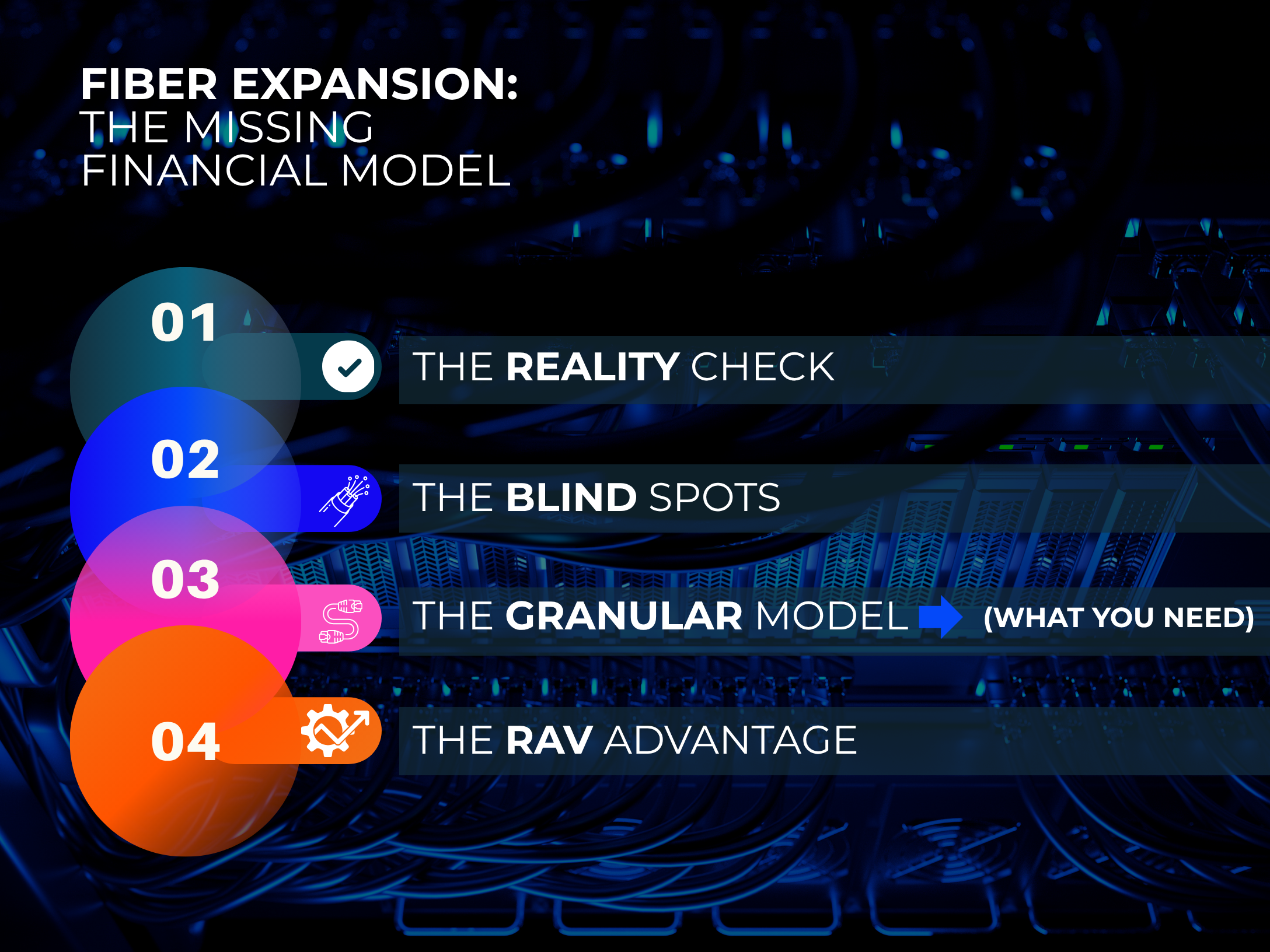
The Real Problem Behind Fiber Investments
At a glance, fiber expansion seems straightforward: build infrastructure, connect subscribers, generate recurring revenue. But the financial reality is far more complex.
Operators often underestimate or fail to fully model:
- The true cost per home passed
- Customer acquisition timelines
- Take-rate assumptions (how many homes / businesses actually convert)
- Time to breakeven
- Ongoing maintenance and operational costs
Pain points you've likely experienced:
- "We invested heavily, but cash flow is tighter than expected."
- "Adoption is slower than we projected."
- "We're not sure when this expansion will actually pay off."
Without a structured financial model, fiber expansion becomes a long-term gamble instead of a strategic investment.
Where Most Financial Models Fall Short
Many telecom operators rely on high-level projections or generic ROI assumptions. But fiber requires granular, scenario-based modeling.
Common mistakes include:
- Overestimating subscriber adoption rates
- Ignoring phased rollout dynamics
- Not modeling different pricing scenarios
- Failing to connect network investment with subscriber profitability
- Lack of sensitivity analysis (best case vs worst case)
This creates a dangerous situation where decisions are made based on optimism instead of financial clarity.
What a Proper Fiber Financial Model Should Include
To make confident expansion decisions, operators need a model that integrates both financial and operational realities.
This includes:
- Cost per mile / cost per home or business passed
- Expected take rates by market
- ARPU assumptions by segment
- Customer acquisition cost
- Churn impact over time
- Time to breakeven and cash flow curves
- Scenario analysis for different rollout strategies
With this level of visibility, leadership can answer critical questions:
- Which investment should we prioritize?
- How fast should we expand?
- What pricing strategy maximizes return?
- When does this investment become cash flow positive?
Turning Fiber Expansion Into a Strategic Advantage
Fiber can be a game-changer — but only if it's backed by financial discipline.
At RAV Strategic Business Solutions, we help telecom operators build telecom-specific financial models that turn complex infrastructure investments into clear, data-driven decisions.
Instead of relying on assumptions, you gain:
- Visibility into true ROI
- Confidence in capital allocation
- Alignment between finance, strategy, and operations
Because the goal isn't just to expand your network — it's to expand it profitably and predictably.
And that starts with a financial model most operators are still missing.
Ready to build your model?